A practical training for psychotherapists
on working with client resistance using a multimodal framework
30-Day Money Back Guarantee. Try the training risk free.
SPECIALIZED TRAINING FOR PSYCHOTHERAPISTS
ADVANCED TRAINING FOR MENTAL HEALTH PROFESSIONALS
SPECIALIZED TRAINING FOR PSYCHOTHERAPISTS
30-Day Money Back Guarantee. Try the training risk free.
A clearer way to work with resistance across different approaches
🛡 30-Day Money Back Guarantee. Try the training risk free.
Why it matters
Research shows that resistance is one of the strongest predictors of therapeutic success or failure
”A 2025 systematic review found a strong link between client resistance and psychotherapy outcomes.”
Koutsoukou-Argyraki et al. (2025)
“Resistance is perhaps the single most important factor in determining the success or failure of the therapeutic enterprise.”
Wachtel (1999)
“Resistance has been shown to reliably predict poorer outcomes.”
Beutler, L. E., Clarkin, J. F., & Bongar, B. (2000)
Why it matters
Research shows that resistance is one of the strongest predictors of therapeutic success or failure
”A 2025 systematic review found a strong link between client resistance and psychotherapy outcomes.”
Koutsoukou-Argyraki et al. (2025)
“Resistance is perhaps the single most important factor in determining the success or failure of the therapeutic enterprise.”
Wachtel (1999)
“Resistance has been shown to reliably predict poorer outcomes.”
Beutler, L. E., Clarkin, J. F., & Bongar, B. (2000)
Understanding resistance and how to work with it brings a clarity that changes how the session feels for both you and the client.
→ I try all the techniques, everything I know, but nothing works.
→ I’m afraid that pushing harder will actually make things worse.
→ If I push, it only brings more resistance and I end up working harder than the client.
→ I become exhausted and start dreading the next session before this one even ends.
→ I catch myself blaming the client and then feeling awful about it.
→ I blame myself, feel guilty, and sometimes walk out feeling quietly incompetent and discouraged.
→ You read resistance like a map instead of fighting against it.
→ You can predict and anticipate resistance before it even shows up.
→ You choose interventions that work with the system, not against it.
→ You avoid the subtle mistakes that make resistance stronger.
→ You know exactly what you can do, and when there is nothing you can do.
→ You turn resistance into a clear and structured plan for treatment.
100% risk free - 30 day money back guarantee
→ I try all the techniques, everything I know, but nothing works.
→ I’m afraid that pushing harder will actually make things worse.
→ If I push, it only brings more resistance and I end up working harder than the client.
→ I become exhausted and start dreading the next session before this one even ends.
→ I catch myself blaming the client and then feeling awful about it.
→ I blame myself, feel guilty, and sometimes walk out feeling quietly incompetent and discouraged.
→ You read resistance like a map instead of fighting against it.
→ You can predict and anticipate resistance before it even shows up.
→ You choose interventions that work with the system, not against it.
→ You avoid the subtle mistakes that make resistance stronger.
→ You know exactly what you can do, and when there is nothing you can do.
→ You turn resistance into a clear and structured plan for treatment.
30-Day Money Back Guarantee. Try the training risk free.
MODULE 1
The Client’s Side of Resistance
What organizes resistance inside the client.
MODULE 2
Your Side of Resistance
How the therapist’s system enters the work.
MODULE 3
The Space Between
Where resistance emerges in the relationship.
1.1 Brief History of Resistance — where the concept came from and why it still matters
1.2 Reich’s Principle — the foundation of modern resistance work
1.3 Take Care of the Resistance — before you take care of anything else
1.4 Case Study: Collapse of Narcissistic Defence
1.5 Behind the Smile — part 2
1.6 The Blueprint — the map underneath all resistance
1.7 No Way Around It — why bypassing resistance always backfires
1.8 Approaching the Structure — one way of conceptualizing it
1.9 Schema Model — viewing personality through the Schema model
1.10 No Bad Parts — personality from an IFS perspective
1.11 Dancing with the Parts — finding parts
1.12 The Mighty Unblending — the essential move
1.13 IFS Showcase — a complete demonstration of parts in action
1.14 Multimodal Approach to Personality — integrating multiple frameworks
1.15 Multimodal Approach (Part 2) — building a unified working model
1.16 Structure Between Parts and Identity — a new way of describing identity structure
1.17 Three Types of Identity Foundation — how the sense of self is organized
1.18 Case Vignette #1
1.19 Case Vignette #2
1.20 Closing of Module 1
2.1 Death of the Resistance — are you resisting resistance?
2.2 The Boat — how therapist and client drift out of sync
2.3 Thinkers and Feelers — a generalized view of the therapist’s tendencies
2.4 Realistic Resistance — when “resistance” is actually healthy self-protection
2.5 Prioritizing Your Agenda — what’s the priority?
2.6 Prioritizing Your Goals in Therapy — aligning direction without pushing
2.7 Collusive Resistance & the One-Size-Fits-All Approach — when the therapist becomes part of the problem
2.8 Performative Empathy — how empathy can create resistance
2.9 Cognitive Distortions & Distorted Intentions — the thinking traps inside the therapist
2.10 Your Worldview & Your Beliefs — how your internal view shapes the session
2.11 Ambivalence: Staying Neutral in the Client’s System — the therapist’s discipline
2.12 Brief Examples — fast illustrations that tie the module together
3.1 Relationship — the space in between
3.2 Self Leadership — keeping your system steady
3.3 Why Do You Care? — why do we even care?
3.4 MAP Protocol — your complete session-to-session roadmap
3.5 Case Vignette #1
3.6 Build Trust and Relational Safety — the precondition for deep work
3.7 Recognize Healthy & Realistic Resistance — not all resistance is a problem
3.8 Case Vignette #2
3.9 First Impressions of Structure & Parts — reading the system quickly and accurately
3.10 Forming Preliminary Hypotheses — how ideas form
3.11 Clarify Therapy Goals Collaboratively — moving from vague to precise
3.13 Case Vignette #3
3.14 Mapping the Internal System — identifying internal architecture
3.15 Identifying the Protector’s Architecture — working with defensive layers
3.16 From Protector to Exile — working with wounded layers
3.17 Case Vignette #4
3.18 Mapping Identity Foundations & Boundaries — where “I” begins, where “I” ends
3.19 Shared Understanding of Dynamics & Symptoms — bringing everything together
3.20 Normalizing Cardinal Resistance — the system’s keystone
3.21 Case Vignette #5
3.22 Translating Goals from a New Perspective — a new view on the initial goals
3.23 Identifying Perpetuating & Immunizing Factors — entangling internal and external factors
3.24 Case Vignette #6
3.25 Top-Down, Bottom-Up, and Identity Expansion — two main directions of work
3.26 Expansion of Identity — expanding from where toward what
3.27 Building & Sustaining Internal Relationship — sustained efforts in reorganization
3.28 Strengthening the Real Self & Reducing Polarization — building the real Self
3.29 Case Vignette #7
3.30 Translating Vectors into Interventions — turning work into precise interventions
3.31 Session-by-Session Implementation — turning interventions into steps and cycles
3.32 Sustaining Motivation for Change — keeping momentum
3.33 Case Vignette #8
3.34 After MAP
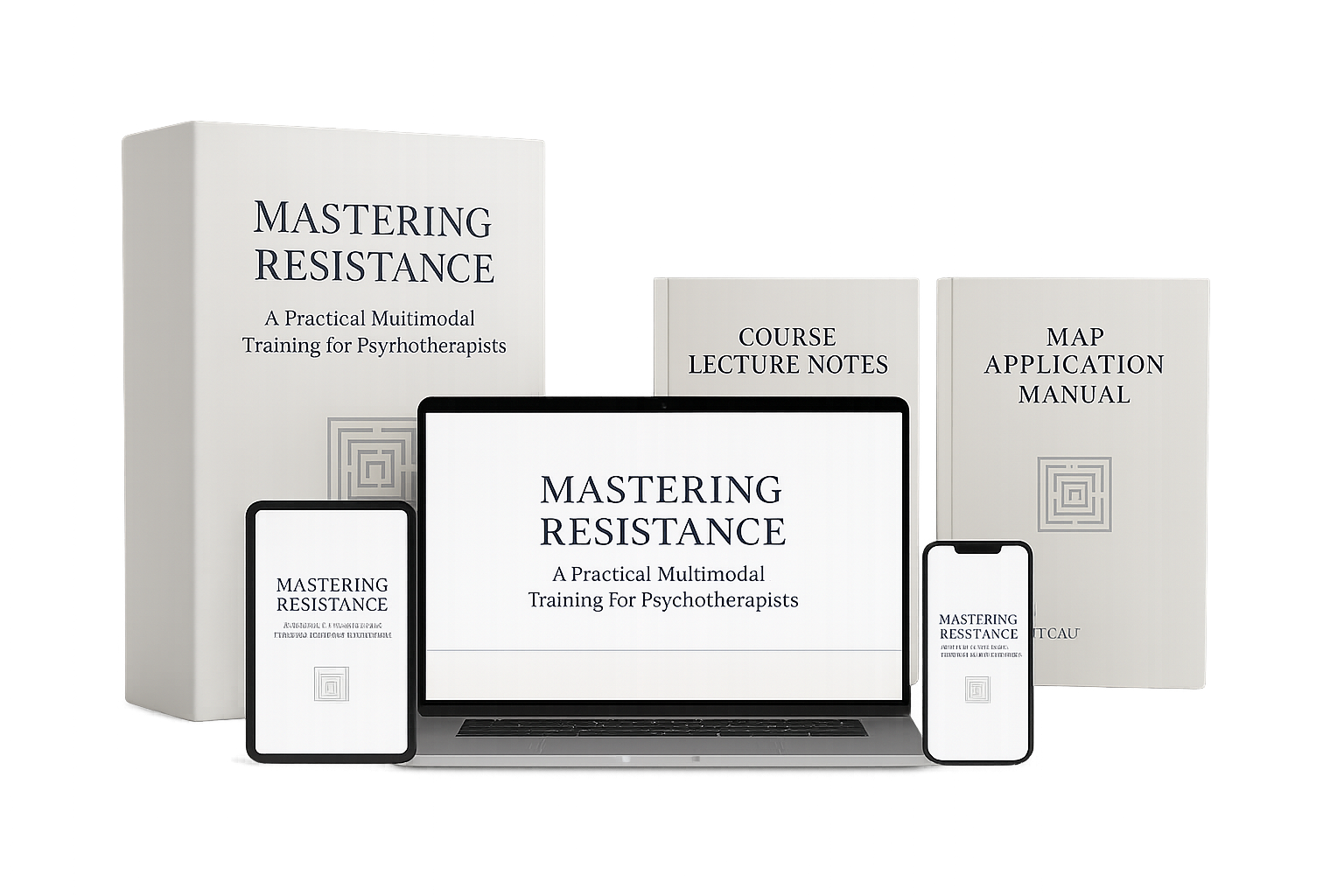
Mastering Resistance:
A Practical Multimodal Training for Psychotherapists
Most therapists were never taught a structured way to understand or respond to resistance.
Multimodal approch gives you a clear system to see what resistance protects, map it in real time, and intervene without strengthening it.
Designed for therapists who want deeper understanding, and a predictable framework for working with resistance.
100% risk free - 30 day money back guarantee
MODULE 1
The Client’s Side of Resistance
MODULE 2
Your Side of Resistance
MODULE 3
The Space Between
&
Step by Step Protocol
1.1 Brief History of Resistance — where the concept came from and why it still matters
1.2 Reich's Principle — the foundation of modern resistance work
1.3 Take Care of the Resistance — before you take care of anything else
1.4 Case Study: Collapse of Narcissistic Defence
1.5 Behind the Smile — (part 2)
1.6 The Blueprint — the map underneath all resistance
1.7 No Way Around It — why bypassing resistance always backfires
1.8 Approaching the Structure — one way of conceptualizing it
1.9 Schema Model — view of the personality from the Schema model
1.10 No Bad Parts — personality from IFS perspective
1.11 Dancing With the Parts — finding parts
1.12 The Mighty Unblending — the essential move
1.13 IFS Showcase — a complete demonstration of parts in action
1.14 Multimodal Approach to Personality — integrating multiple frameworks...
1.15 Multimodal Approach (Part 2) — ...building a unified working model
1.16 Structure Between Parts and Identity — a new way of describing identity structure
1.17 Three Types of Identity Foundation — how the sense of self is organized
1.18 Case Vignette #1
1.19 Case Vignette #2
1.20 Closing of Module 1
2.1 Death of the Resistance — are you resisting resistance?
2.2 The Boat — how therapist and client drift out of sync
2.3 Thinkers and Feelers — generalized view of the therapist's tendencies
2.4 Realistic Resistance — when “resistance” is actually healthy self-protection
2.5 Prioritizing Your Agenda — what's the priority?
2.6 Prioritizing Your Goals in Therapy — aligning direction without pushing
2.7 Collusive Resistance & the One-Size-Fits-All Approach — when the therapist becomes part of the problem
2.8 Performative Empathy — how can empathy create resistance
2.9 Cognitive Distortions & Distorted Intentions — the thinking traps inside the therapist
2.10 Your Worldview & Your Beliefs — how your internal view shapes the session
2.11 Ambivalence: Staying Neutral in the Client’s System — the therapist’s discipline
2.12 Brief Examples — fast illustrations that tie the module together
3.1 Relationship — the space in between
3.2 Self Leadership — keeping your system steady
3.3 Why Do You Care?
3.4 MAP Protocol — your complete session-to-session roadmap
3.5 Case Vignette #1
3.6 Build Trust and Relational Safety — the precondition for deep work
3.7 Recognize Healthy & Realistic Resistance — not all resistance is a problem
3.8 Case Vignette #2
3.9 First Impressions of Structure & Parts — reading the system quickly and accurately
3.10 Forming Preliminary Hypotheses — how ideas form
3.11 Clarify Therapy Goals Collaboratively — moving from vague to precise
3.13 Case Vignette #3
3.14 Mapping the Internal System — identifying internal architecture
3.15 Identifying the Protector’s Architecture — working with defensive layers
3.16 From Protector to Exile — working with wounded layers
3.17 Case Vignette #4
3.18 Mapping Identity Foundations & Boundaries — where "I" begins, where "I" ends
3.19 Shared Understanding of Dynamics & Symptoms — bringing everything together
3.20 Normalizing Cardinal Resistance — the system's keystone
3.21 Case Vignette #5
3.22 Translating Goals from the New Perspective — new view on the initial goals
3.23 Identifying Perpetuating & Immunizing Factors — entangling internal and external
3.24 Case Vignette #6
3.25 Top-Down, Bottom-Up, and Identity Expansion — two main directions of work
3.26 Expansion of Identity — from where towards what
3.27 Building & Sustaining Internal Relationship — sustained efforts in reorganization
3.28 Strengthening the Real Self & Reducing Polarization — building real Self
3.29 Case Vignette #7
3.30 Translating Vectors into Interventions — turning work into precise interventions
3.31 Session-by-Session Implementation — turning interventions into steps & cycles
3.32 Sustaining Motivation for Change — keeping momentum
3.33 Case Vignette #8
3.34 After MAP
30-Day Money Back Guarantee. Try the training risk free.
Mastering Resistance:
Practical Multimodal Training
for Psychotherapists
Most therapists were never taught a structured way to understand or respond to resistance.
Multimodal approch gives you a clear system to map it in real time and intervene without strengthening it.
Designed for therapists who want deeper understanding, and a predictable framework for working with resistance.
• You stop feeling lost when resistance appears
• You understand why sessions stall instead of guessing
• You stop working harder than the client
• You feel less pressure to fix or force change
• You leave sessions less drained and self critical
• You stop carrying therapeutic stress home
• You regain a sense of professional steadiness
• You anticipate resistance before it escalates
• You understand what each form of resistance protects
• You stop being surprised by the sudden emergence of resistance
• You recognize when resistance signals a limit
• You respond without strengthening defenses
• You avoid misreading resistance as a lack of motivation
• You maintain direction even when progress slows
• You always know where you are in the process
• You understand what is possible next and what is not
• You translate resistance into clinical decisions
• You stop chasing interventions that do not land
• You work with consistency across sessions
• You organize sessions around structure rather than urgency
• You reduce trial and error in difficult work
• You understand the function of protectors
• You see how identity organization shapes resistance
• You track the relationship between parts in real time
• You recognize structural adaptations rather than symptoms
• You understand why insight alone does not create change
• You integrate multiple models into one coherent map
• You stop pathologizing what is actually protective
• You stay grounded when resistance intensifies
• You trust your clinical judgment more consistently
• You feel less reactive in challenging moments
• You protect the therapeutic alliance more reliably
• You know when to intervene and when not to
• You feel clearer about your role in the process
• You leave sessions knowing you did the right thing
100% risk free - 30 day money back guarantee
• You stop feeling lost when resistance appears
• You understand why sessions stall instead of guessing
• You stop working harder than the client
• You feel less pressure to fix or force change
• You leave sessions less drained and self critical
• You stop carrying therapeutic stress home
• You regain a sense of professional steadiness
• You anticipate resistance before it escalates
• You understand what each form of resistance protects
• You stop being surprised by shutdown or avoidance
• You recognize when resistance signals a limit
• You respond without strengthening defenses
• You avoid misreading resistance as lack of motivation
• You maintain direction even when progress slows
• You always know where you are in the process
• You understand what is possible next and what is not
• You translate resistance into clinical decisions
• You stop chasing interventions that do not land
• You work with consistency across sessions
• You organize sessions around structure rather than urgency
• You reduce trial and error in difficult work
• You understand the function of protectors
• You see how identity organization shapes resistance
• You track the relationship between parts in real time
• You recognize structural adaptations rather than symptoms
• You understand why insight alone does not create change
• You integrate multiple models into one coherent map
• You stop pathologizing what is actually protective
• You stay grounded when resistance intensifies
• You trust your clinical judgment more consistently
• You feel less reactive in challenging moments
• You protect the therapeutic alliance more reliably
• You know when to intervene and when not to
• You feel clearer about your role in the process
• You leave sessions knowing you did the right thing
How to join the training:
120 €
Early access price
Pay in 2 instalments of EUR 60
Same full access, split across two payments
100% risk free - 30 day money back guarantee
• Over 10 hours of in-depth video training
• Full course lecture notes
• MAP Application Manual for clinical use
• Case examples, reflective questions, and application exercises
• Lifetime access to all materials
120 €
Early access price
Pay in 2 instalments of EUR 60
Same full access, split across two payments
• Over 10 hours of in-depth video training
• Full course lecture notes
• MAP Application Manual for clinical use
• Case examples, reflective questions, and application exercises
• Lifetime access to all materials
I’m Vladimir T. Katusic, a psychologist based in Zagreb, Croatia, trained in Gestalt therapy (IGW-ZG) and other modalities.
I have taught and lectured in professional and academic settings, and over the past few years have focused on bringing together what I consider essential for working with resistance, out of a simple realisation of how central this issue is in therapy, and how little formal education is devoted to it.
I am a psychologist trained in Gestalt therapy and other modalities (IGW - Zagreb, Croatia), working at the intersection of practice and teaching. Alongside my work with clients, I have taught and lectured in academic and professional settings (for example, programs for psychotherapists at Prague Integration and lectures at Edward Bernays University in Zagreb, Srebrenjak Hospital, Zagreb).
My work sits between theory and lived experience, with a particular focus on how psychological ideas translate into what actually happens in the room. This course grew directly out of years of working with clients and therapists who felt technically competent, yet repeatedly stuck when resistance entered the process. Rather than approaching resistance as an obstacle to be overcome, the work presented here treats it as a meaningful and organised response that deserves understanding before intervention.
•
The framework presented in this training has been developed and refined through work with practicing therapists across different settings, including private practice, training programs, and academic environments.
There 10+ hours of video material, and with additional exercises, that would translate into a weekend seminar. The training is self-paced and designed for busy therapists. You can move through it gradually and return to specific sections as many times as you want. Lifetime access means there’s no pressure to rush.
The training integrates theory only where it directly informs practice. Concepts are tied back to session-level decisions: to translate moments into next steps with a real client.
No. The framework is intentionally integrative. It draws from IFS, Gestalt, psychodynamic, trauma-informed, and relational perspectives, and is designed to sit under your existing approach rather than replace it.
That hesitation is understandable. This course is best suited for therapists who seek depth, structure, and clarity, rather than quick techniques or motivational hype. If you resonate with the idea that resistance isn't simply "just a client being resistant", you’re likely in the right place.
This course is best suited for therapists who already have some practical experience. That said, if you’re early in your practice, the framework can still be valuable as a way of organising how you think about clients, resistance, and pacing. You don’t need to be an expert in any specific model, but some familiarity with therapeutic work will help you get the most out of the material.
Yes. While the course is designed primarily for therapists, it also has strong psychoeducational value, particularly in helping to understand the structure of the psyche. Many of the concepts explore how resistance, protection, and inner conflicts operate in human experience more generally. Professional jargon is kept to a minimum, only where necessary, and all relevant concepts are fully explained. That said, the material is developed with therapists’ clinical questions and challenges in mind. Additionally, you may gain insight into why your previous therapy, if you have had any, worked or didn’t work
Some of the language used in this training overlaps with IFS because it provides a clear and accessible way of describing internal dynamics. While the course draws from multiple therapeutic traditions, I chose to work primarily within one consistent terminology so ideas could be followed, integrated, and applied more easily.
The framework used here goes beyond IFS alone and integrates perspectives that are not part of standard IFS theory. The terminology is used as a shared language, not as a statement of theoretical allegiance. The focus remains on understanding resistance as it actually appears in real sessions, rather than on adhering to any single model.
There is 10+ hours of video material, and with additional exercises, that would translate into a weekend seminar. The training is self-paced and designed for busy therapists in bite-sized lessons. You can move through it gradually and return to specific sections as many times as you want.
The training integrates theory only where it directly informs practice. Concepts are tied back to session-level decisions: to translate moments into next steps with a real client.
No. The framework is intentionally integrative. It draws from IFS, Gestalt, psychodynamic, trauma-informed, and relational perspectives, and is designed to sit under your existing approach rather than replace it.
That hesitation is understandable. This course is best suited for therapists who seek depth, structure, and clarity, rather than quick techniques or motivational hype. If you resonate with the idea that resistance isn't simply "just a client being resistant", you’re likely in the right place.
This course is best suited for therapists who already have some practical experience. That said, if you’re early in your practice, the framework can still be valuable as a way of organising how you think about clients, resistance, and pacing. You don’t need to be an expert in any specific model, but some familiarity with therapeutic work will help you get the most out of the material.
Yes. While the course is designed primarily for therapists, it also has strong psychoeducational value, particularly in helping to understand the structure of the psyche. Many of the concepts explore how resistance, protection, and inner conflicts operate in human experience more generally. Professional jargon is kept to a minimum, only where necessary, and all relevant concepts are fully explained. That said, the material is developed with therapists’ clinical questions and challenges in mind. Additionally, you may gain insight into why your previous therapy, if you have had any, worked or didn’t work
Some of the language used in this training overlaps with IFS because it provides a clear and accessible way of describing internal dynamics. While the course draws from multiple therapeutic traditions, I chose to work primarily within one consistent terminology so ideas could be followed, integrated, and applied more easily.
The framework used here goes beyond IFS alone and integrates perspectives that are not part of standard IFS theory. The terminology is used as a shared language, not as a statement of theoretical allegiance. The focus remains on understanding resistance as it actually appears in real sessions, rather than on adhering to any single model.
100% risk free - 30 day money back guarantee